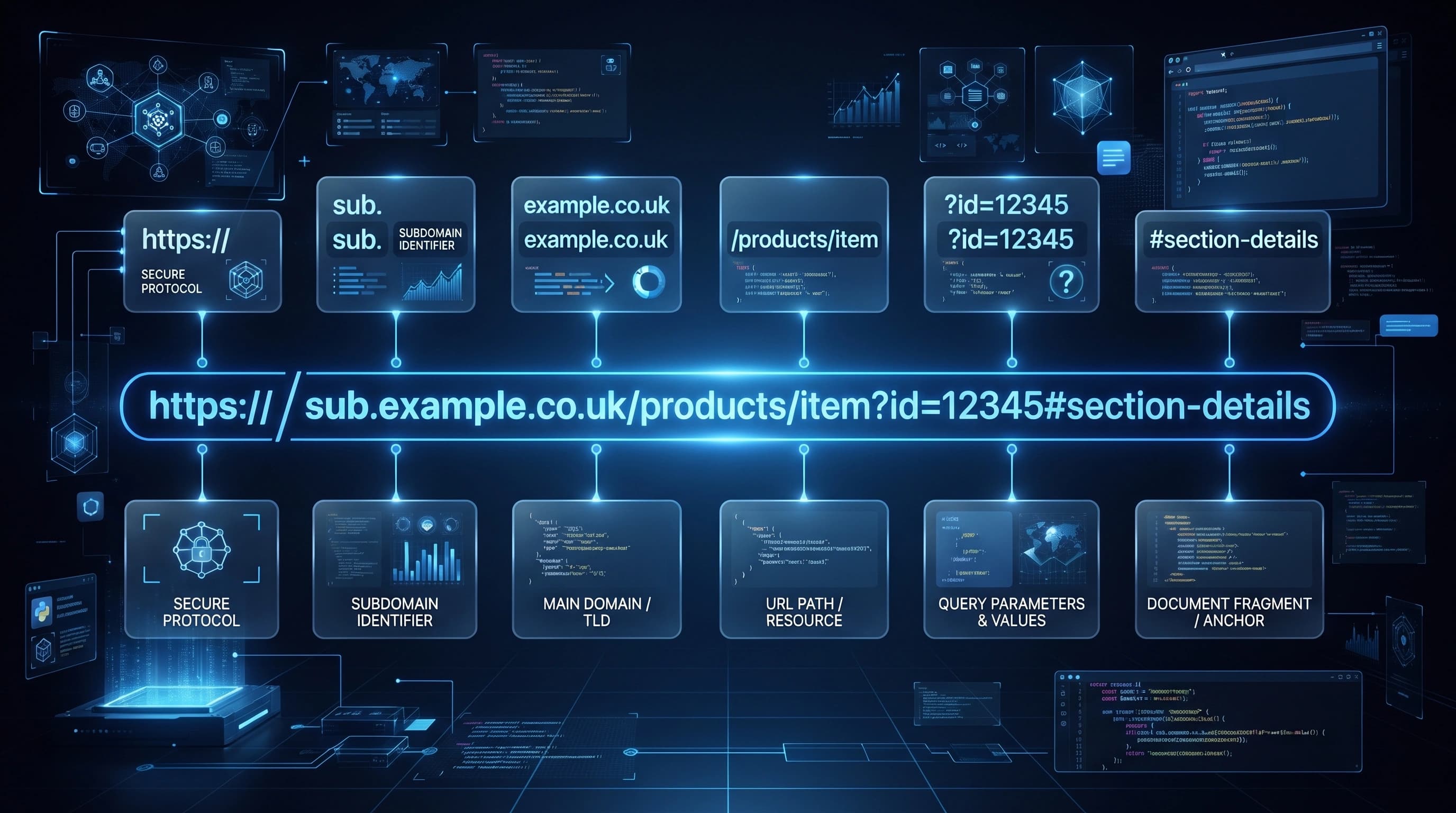
How to Parse URLs Online
Every website address contains multiple pieces of information. While a URL may look like a simple web address, it actually includes several components such as the protocol, domain, path, query parameters, and fragments.
A URL Parser helps developers and website owners break down these components into an organized format, making URLs much easier to understand and debug.
What Is a URL Parser?
A URL Parser is an online tool that analyzes a URL and separates it into individual sections.
Instead of manually identifying each part, the parser automatically extracts important components such as:
- Protocol
- Hostname
- Domain
- Port
- Path
- Query parameters
- Fragment (Anchor)
This makes URL analysis faster and more accurate.
Why URL Parsing Matters
URLs are used throughout websites, APIs, applications, and browsers.
Understanding URL structure helps developers:
- Debug web applications
- Analyze incoming requests
- Extract query parameters
- Build APIs
- Troubleshoot redirects
- Improve website development
- Understand routing systems
Proper URL parsing saves time during development and debugging.
Basic Structure of a URL
A standard URL may look like this:
https://www.example.com/products?id=25&category=books#reviews
A parser separates it into:
- Protocol: https
- Hostname: www.example.com
- Path: /products
- Query Parameters:
- id = 25
- category = books
- Fragment: reviews
Viewing URLs in this structured format makes them much easier to understand.
How to Parse URLs Online
Using the ToolsNestX URL Parser is simple.
- Paste the complete URL.
- Click Parse URL.
- View every URL component.
- Copy the extracted information if needed.
The tool processes URLs instantly without modifying the original address.
Common Uses of URL Parsing
URL parsing is useful in many real-world development scenarios.
Some common use cases include:
- Web application development
- REST API debugging
- Tracking marketing campaigns
- SEO analysis
- Redirect troubleshooting
- Analytics implementation
- Query parameter extraction
- Website testing
Developers frequently analyze URLs while building and maintaining modern websites and applications.
Benefits of Using an Online URL Parser
An online URL Parser offers several advantages over manually inspecting URLs.
Benefits include:
- Instant URL analysis
- Better understanding of URL structure
- Easy extraction of query parameters
- Faster debugging
- No software installation
- Browser-based tool
- Free to use
- Accurate results
Instead of manually separating each part of a URL, the parser does everything automatically.
Common URL Parsing Mistakes
Manually reading URLs often leads to mistakes.
Avoid these common errors:
- Confusing the hostname with the path.
- Missing query parameters.
- Ignoring fragments (#).
- Misreading encoded URLs.
- Forgetting the protocol.
- Mixing domains and subdomains.
Using a URL Parser removes guesswork and displays every component clearly.
Who Should Use a URL Parser?
A URL Parser is useful for many professionals, including:
- Web developers
- Backend developers
- Frontend developers
- SEO specialists
- Digital marketers
- QA engineers
- API developers
- Students learning web development
Anyone working with websites or web applications can benefit from understanding URL structures.
Does URL Parsing Change the URL?
No.
A URL Parser only analyzes the URL and displays its individual components.
It does not modify:
- Protocol
- Domain
- Path
- Query parameters
- Fragment
Your original URL always remains unchanged.
Why Choose ToolsNestX URL Parser?
The ToolsNestX URL Parser is designed to analyze URLs quickly and accurately.
Features include:
- Instant URL analysis
- Automatic component extraction
- Easy-to-read results
- Browser-based tool
- No installation required
- Free to use
- Mobile-friendly interface
- Fast performance
Simply paste a URL, click Parse URL, and instantly view every part of the web address.
Conclusion
Understanding URL structures is an essential skill for developers, SEO professionals, and anyone working with websites. Instead of manually identifying protocols, domains, paths, and query parameters, an online URL Parser performs the analysis instantly.
The ToolsNestX URL Parser makes URL inspection simple, accurate, and efficient, helping developers troubleshoot applications, analyze links, and better understand how web addresses are structured.