How to Convert Unix Timestamps Online
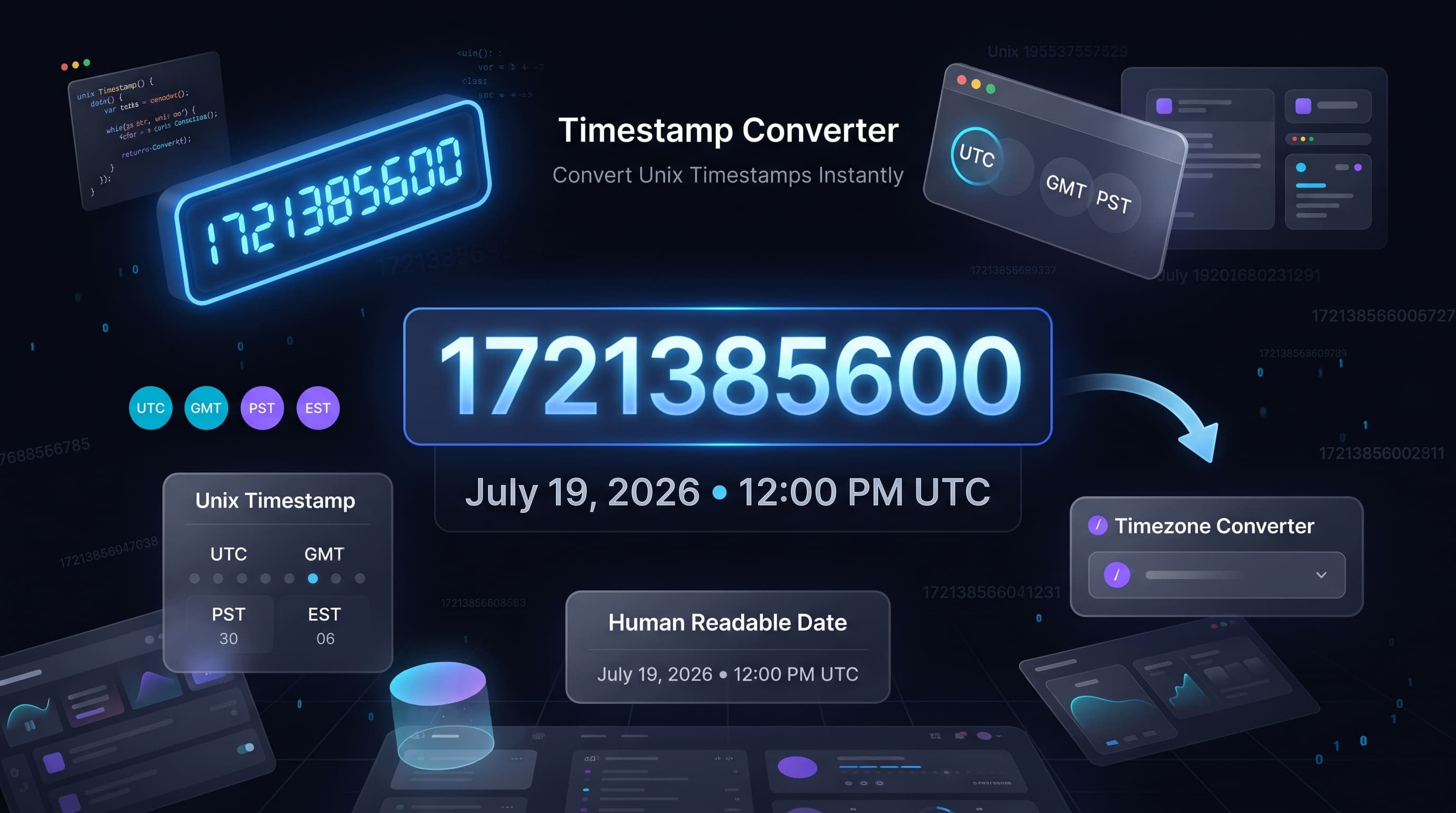
A Timestamp Converter is an essential tool for developers, system administrators, database engineers, and anyone working with Unix time. It allows you to quickly convert Unix timestamps into human-readable dates and also convert dates back into Unix timestamps.
Whether you're debugging an application, working with APIs, reading server logs, or managing databases, timestamp conversion is something you'll use regularly.
Our free Timestamp Converter makes this process fast, accurate, and simple.
What is a Unix Timestamp?
A Unix timestamp (also called Epoch Time) is the number of seconds that have passed since January 1, 1970, 00:00:00 UTC.
Instead of storing long date strings, computers store time as a single integer, making calculations much faster.
Example:
Unix Timestamp
1719859200
Readable Date
July 2, 2024 12:00:00 UTC
Why are Unix Timestamps Used?
Unix timestamps provide a universal way to store and exchange dates across different operating systems, databases, and programming languages.
Benefits include:
- Faster date calculations
- Universal time format
- Easy database storage
- API compatibility
- Cross-platform support
- Better performance
- Consistent timezone handling
- Simple comparisons
Common Uses of Timestamp Converters
Timestamp converters are used in many industries.
Popular use cases include:
- API development
- Database management
- Server logs
- Mobile app development
- Website analytics
- Cybersecurity
- Event scheduling
- Cloud applications
- Software debugging
- Backup systems
Seconds vs Milliseconds
One of the most common mistakes developers make is confusing seconds and milliseconds.
Unix Timestamp (Seconds)
Example
1719859200
Contains 10 digits.
Unix Timestamp (Milliseconds)
Example
1719859200000
Contains 13 digits.
JavaScript commonly uses milliseconds, while many APIs and databases use seconds.
Always verify which format your application requires.
Advantages of Using a Timestamp Converter
Using an online Timestamp Converter saves time and eliminates manual calculations.
Benefits include:
- Instant conversion
- Accurate results
- No software installation
- Works on every device
- Free to use
- Beginner friendly
- Supports both conversion directions
- Helpful for debugging
- Easy to copy results
How to Convert Unix Timestamps Online
Converting timestamps online is quick and easy.
Simply follow these steps:
- Open the Timestamp Converter tool.
- Enter your Unix timestamp.
- Click Convert.
- Instantly view the human-readable date and time.
- Copy the converted result.
You can also convert a normal date back into a Unix timestamp using the same tool.
Timestamp Formats Supported
Most modern applications use one of these formats.
Unix Timestamp (Seconds)
A standard Unix timestamp contains 10 digits.
Example:
1719859200
Used in:
- Linux
- PHP
- Python
- MySQL
- PostgreSQL
- REST APIs
Unix Timestamp (Milliseconds)
A millisecond timestamp contains 13 digits.
Example:
1719859200000
Commonly used by:
- JavaScript
- Node.js
- Firebase
- MongoDB
- Browser applications
Why Developers Use Timestamp Converters
Developers work with timestamps almost every day.
A Timestamp Converter helps when:
- Reading API responses
- Debugging backend services
- Working with databases
- Building mobile apps
- Creating scheduling systems
- Tracking user activity
- Monitoring server logs
- Testing authentication tokens
Instead of calculating dates manually, developers can instantly convert timestamps and continue working more efficiently.
Best Practices
To avoid errors when working with timestamps, follow these recommendations.
- Always verify whether your timestamp is in seconds or milliseconds.
- Store timestamps in UTC whenever possible.
- Convert timestamps to local time only when displaying them to users.
- Avoid manually calculating timestamps.
- Use trusted conversion tools for accurate results.
- Double-check timezone differences before deployment.
Common Mistakes
Many beginners make simple mistakes while working with Unix timestamps.
Some common issues include:
- Mixing seconds with milliseconds.
- Forgetting timezone conversions.
- Assuming every system uses local time.
- Entering invalid timestamp values.
- Ignoring daylight saving time.
- Comparing timestamps from different time zones.
Understanding these differences helps prevent unexpected bugs in applications.
Examples of Timestamp Usage
Unix timestamps appear in many popular technologies.
Examples include:
- User login history
- Order creation dates
- Payment systems
- Chat applications
- Social media posts
- Cloud storage
- Server monitoring
- Database records
- Backup systems
- Event scheduling
Whenever accurate time tracking is required, timestamps are usually involved.
Why Use an Online Timestamp Converter?
Our free Timestamp Converter offers several advantages.
- Completely free
- No registration required
- Fast conversion
- Instant results
- Mobile friendly
- Browser-based processing
- Accurate UTC conversion
- Supports both directions
- Beginner friendly
- Developer friendly
Whether you are a student learning programming or an experienced software engineer, our Timestamp Converter makes working with Unix time much easier.
Frequently Asked Questions
What is Unix Epoch?
Unix Epoch refers to January 1, 1970 at 00:00:00 UTC. Every Unix timestamp counts the number of seconds or milliseconds that have passed since this date.
Can I convert timestamps both ways?
Yes. You can convert Unix timestamps into readable dates and convert readable dates back into Unix timestamps.
Why do some timestamps have 10 digits and others have 13 digits?
Ten-digit timestamps represent seconds, while thirteen-digit timestamps represent milliseconds.
Does timezone affect Unix timestamps?
The Unix timestamp itself is always based on UTC. Only the displayed date changes depending on the selected timezone.
Is this Timestamp Converter free?
Yes. Our Timestamp Converter is completely free and works directly inside your browser without requiring any downloads.
Conclusion
A Timestamp Converter is one of the most useful utilities for developers, database administrators, DevOps engineers, and IT professionals. It simplifies the process of converting Unix timestamps into readable dates and converting dates back into timestamps with just a few clicks.
Whether you're debugging an API, checking server logs, storing database records, or building modern web applications, a reliable Timestamp Converter saves time and reduces errors. Our free online Timestamp Converter provides accurate, fast, and secure conversions, making it an essential tool for anyone working with dates and time in software development.